Why ROAS Drops After 30 Days (And Recovery Plan)
If your campaign starts strong and then weakens after 30 days, this guide explains why ROAS drops and gives a practical week-by-week recovery framework.
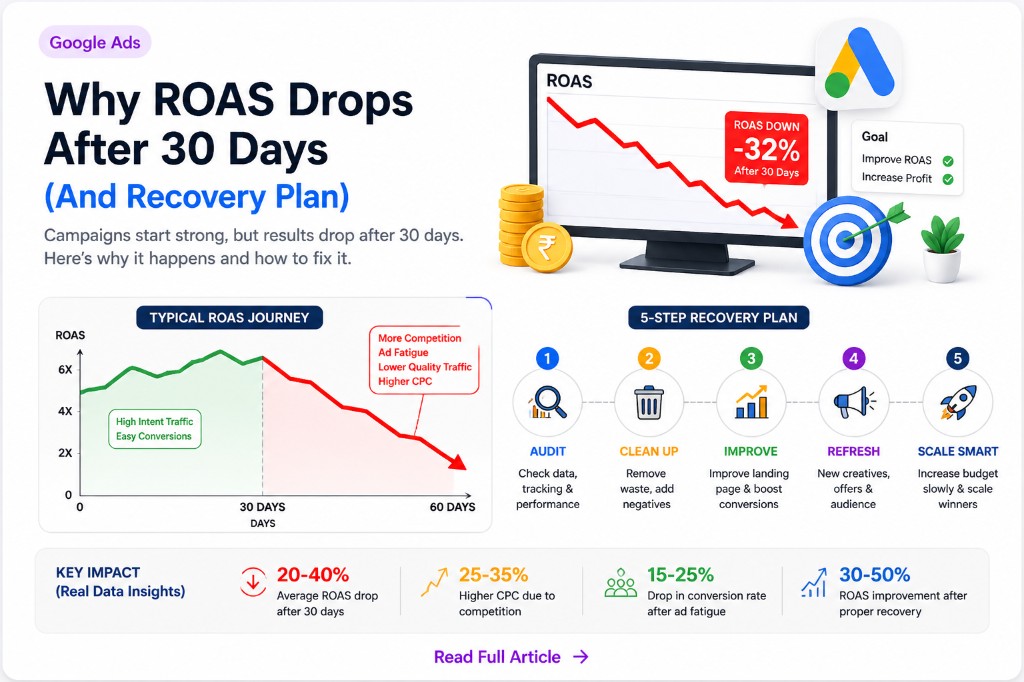
If your Google Ads campaign starts strong, delivers profitable returns in the first few weeks, and then suddenly your ROAS begins to decline after 30 days, you are not alone.
Many advertisers experience this pattern. The campaign launches, performance looks promising, conversions roll in, and then results slowly weaken. Cost per conversion rises, click quality drops, and revenue no longer matches ad spend.
This is not random.
There are clear reasons why ROAS drops after the first month, and more importantly, there are practical ways to recover performance without restarting everything.
In this guide, we’ll explain why it happens, how to diagnose the issue, and what actions you should take to restore profitable returns.
What Is ROAS?
ROAS stands for Return on Ad Spend.
Formula:
ROAS = Revenue Generated ÷ Advertising Cost
Example:
Spend: ₹50,000
Revenue: ₹250,000
ROAS = 5X
That means every ₹1 spent generated ₹5 in revenue.
When ROAS falls after 30 days, it means your campaign efficiency is declining.
Why ROAS Commonly Drops After 30 Days
1. The Easy Conversions Already Happened
During the first few weeks, your ads often reach existing demand, warm audiences, branded searchers, and high-intent users ready to buy.
After that, campaigns start reaching colder traffic segments, where conversion rates are naturally lower.
Recovery Plan:
- Separate branded campaigns
- High-intent keyword campaigns
- Cold prospecting traffic
- Remarketing audiences
Do not judge all traffic using one blended ROAS number.
2. Ad Fatigue Begins
When users repeatedly see the same ad creatives, CTR declines. This is especially common in Display, YouTube, Meta, and Performance Max asset groups.
Recovery Plan: Refresh creative assets every 3–4 weeks with new headlines, images, offers, CTA angles, and video hooks.
3. Google’s Learning Phase Ended Into Poor Optimization
Sometimes campaigns exit learning mode but optimize toward wrong signals: low-value conversions, junk leads, duplicate conversions, or incorrect values.
Recovery Plan: Audit conversion tracking immediately.
- Primary conversions
- Duplicate events
- Revenue values
- Call tracking quality
- Lead qualification accuracy
Bad data always creates bad automation.
4. Competition Increased
Month two may bring seasonal bidding pressure, new competitors, aggressive promotions, and CPC inflation.
Recovery Plan: Review auction insights and impression share. If CPC rises, improve Quality Score, tighten keyword intent, strengthen ad copy, remove weak geographies, and shift budget to profitable hours/devices.
5. Search Terms Expanded Too Far
Broad match and automated campaigns often expand over time. You may begin showing for informational or irrelevant terms.
Recovery Plan: Review search terms weekly and add negative keywords like free, jobs, training, meaning, course, and cheap (if irrelevant).
6. Landing Page Conversion Rate Dropped
Sometimes ads are fine, but the landing page weakens due to speed issues, form errors, mobile UX friction, offer fatigue, or missing trust signals.
Recovery Plan: Check mobile speed, form completion rate, bounce rate, heatmaps, and checkout abandonment. Test simpler forms, faster pages, better CTA placement, stronger guarantees, and testimonials.
7. Budget Scaling Reduced Efficiency
Many businesses increase budgets aggressively after early wins. This can force platforms to buy lower-quality traffic.
Recovery Plan: Scale gradually (10–20% every few days), monitor CPA and ROAS, and expand with new campaigns instead of forcing one campaign.
30-Day ROAS Recovery Framework
Week 1: Diagnose
Audit conversion tracking, search terms, device performance, audience segments, ad fatigue, and landing page metrics. Pause emotional decisions. Use data.
Week 2: Clean Up Waste
- Add negatives
- Pause weak keywords
- Exclude poor locations
- Cut weak audiences
- Fix broken tracking
- Reduce bad placements
Week 3: Improve Conversion Rate
- Test a new landing page variant
- Improve speed
- Shorten forms
- Add trust proof
- Improve CTA clarity
Even a 20% lift in conversion rate can restore ROAS quickly.
Week 4: Relaunch Growth Carefully
- Introduce new creatives
- Add remarketing layers
- Increase budget slowly
- Test new offers
- Expand only winning segments
Important Metrics to Watch During Recovery
Focus on these instead of ROAS alone:
- Conversion Rate
- Cost Per Conversion
- Average Order Value
- CTR
- Search Impression Share
- New vs Returning Customers
- Lead Quality
ROAS is the final result, not the only metric.
What Most Advertisers Do Wrong
When ROAS drops, many businesses panic and stop campaigns, increase budget blindly, change everything at once, ignore tracking issues, or blame platform algorithms. This usually makes performance worse.
Real Example
A home services advertiser launched with Spend: ₹80,000, Revenue: ₹480,000, ROAS: 6X.
After 35 days: Spend: ₹110,000, Revenue: ₹330,000, ROAS: 3X.
Issues found: broad match drift, duplicate form tracking, slow mobile page, and competitor bidding spike.
After fixes (negatives, landing page rebuild, ad refresh, campaign segmentation), ROAS recovered to 5.2X within 21 days.
Final Thoughts
ROAS dropping after 30 days is common because campaigns evolve, audiences change, competition increases, and weak systems get exposed over time.
The solution is not to restart blindly. The solution is structured optimization: fix data, remove waste, improve conversion rate, refresh creatives, and scale carefully.
When handled properly, many campaigns recover stronger than their launch phase.
Need Help Recovering ROAS?
If your campaign performed well initially but is now declining, a professional audit can identify where profit is leaking and how to restore results quickly. Contact Adswadi today.
Ready to Fix Your Google Ads?
Get expert help from Adswadi's Google Ads specialists today.