Google Ads in 2026 isn't about clever keyword lists anymore — Performance Max now runs most of the auction, and the account managers who win are the ones feeding it the right signals instead of fighting it. Here's the complete Google Ads playbook we use for clients.
1. Which Google Ads type fits your business
Most accounts underperform because they run the wrong campaign type, not because of bad targeting. Here's the quick map we start every client with:
- Search Ads — text ads on Google results for people actively typing what they want. Best for local service businesses (clinics, salons, coaching, home services) and anyone with clear buyer-intent keywords.
- Shopping Ads — product image, price and store name shown directly in search results. Built for e-commerce and Shopify stores with a real product feed.
- Display Ads — banner creatives across millions of partner sites and apps. Good for brand awareness and retargeting visitors who didn't convert, not cold first-touch sales.
- Video & YouTube Ads — run before, during or alongside YouTube content. Best for brands with a strong story or demo — coaching, SaaS, D2C brands with good creative.
- App Campaigns — promote installs and in-app actions across Search, Display, YouTube and the Play Store. Only worth running once you actually have an app.
- Performance Max — combines all formats into one AI-managed campaign. The easiest starting point for most small and mid-size brands who want reach without managing five campaign types manually.
- Demand Gen — targets by interest and behaviour across YouTube, Discover and Gmail with rich visual ads. Well suited to lifestyle, fashion and beauty brands leaning on strong imagery.
- Local Services Ads — pay per lead instead of per click, with a Google Guaranteed badge. Ideal for home services, legal and medical practices that want verified leads over website traffic.
Not sure which type fits your business? Book a free strategy call and we'll map it out for you.
2. Fix conversion tracking before spending a rupee
Performance Max and Smart Bidding are only as good as the data you feed them. Get tracking wrong and Google optimizes toward the wrong outcome — confidently. Non-negotiables in 2026:
- GA4 + Google Ads linked properly, with a single primary conversion action marked — not five "conversions" competing for the algorithm's attention.
- Enhanced Conversions turned on. Hashed first-party data (email, phone) recovers conversions lost to cookie restrictions and Consent Mode, often 15–25% more than click-based tracking alone.
- Offline conversion imports for lead-gen businesses. Push "qualified lead" and "closed sale" events back from your CRM using GCLID — Google can only optimize for revenue if it knows which leads actually became customers.
3. Performance Max vs Search: use both, not one
PMax is the default recommendation Google pushes, and it does work — but running it alone means giving up control over exactly where your money goes. What works now:
- 1 Performance Max campaign as your always-on demand-capture engine across Search, Display, YouTube, Discover and Gmail.
- 1 Search campaign with exact/phrase match for your highest-intent, highest-value keywords (brand terms, "near me", "buy" intent) — this protects your best traffic from PMax's broader, less predictable targeting.
- Account-level negative keywords applied to both, so PMax doesn't quietly spend on irrelevant searches Search campaigns would normally block.
Rule of thumb: if you can't see where a rupee went, you can't fix it. Keep at least one campaign type where you control the keywords directly.
4. Asset groups are the new ad groups
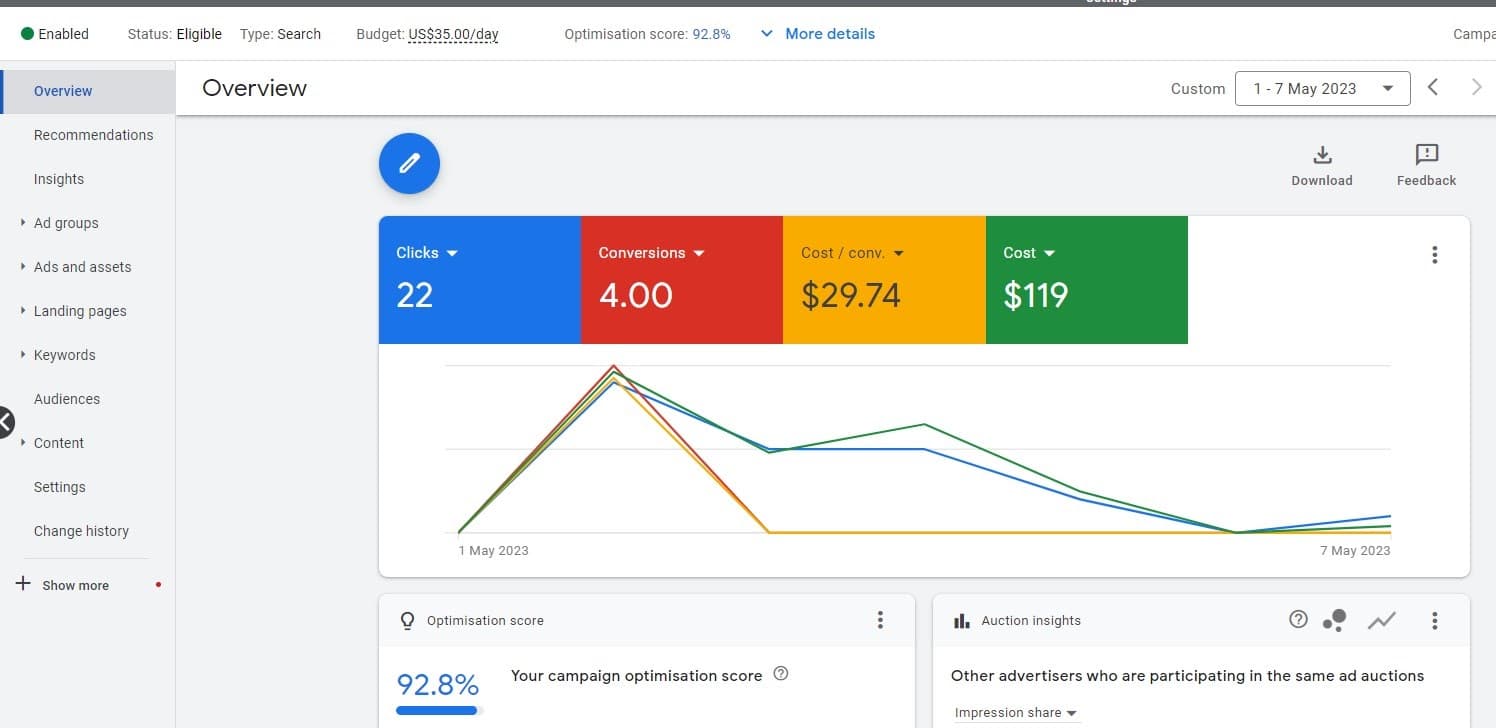
Inside Performance Max, targeting has shrunk — so your asset group (headlines, descriptions, images, videos, audience signals) is doing the job keywords used to do. Our approach for every client:
- Build 2–3 distinct asset groups per campaign, one per product line or audience — not one giant group for everything.
- Feed real audience signals (customer match lists, website visitors, competitor interest) so PMax has a head start instead of guessing cold.
- Check the asset group strength and Insights tab weekly; swap out "Low" performing headlines and images, keep feeding fresh creative monthly.
5. Budgets that actually work in India
| Business type | Minimum monthly spend | Realistic expectation |
|---|---|---|
| Local lead gen | ₹15,000–₹35,000 | Calls/form fills from week 1, stable CPL by week 3–4 |
| E-commerce / D2C | ₹35,000–₹60,000 | Learning phase 2 weeks, ROAS clarity by day 30–45 |
| Scaling brand | ₹1.5L+ | Layer in Search + PMax + YouTube once core funnel is proven |
6. The 2026 mistakes to avoid
- Launching Performance Max with zero negative keywords — it will spend on searches you'd never approve manually.
- Judging a new campaign inside the first 2 weeks — Smart Bidding needs a full learning phase (roughly 30–50 conversions) before the data means anything.
- Ignoring the Search Terms Insights report — it's the closest thing to a keyword report PMax gives you, and it's easy to miss.
- Reusing the same 3 headlines for months — asset fatigue quietly raises your CPA just like on Meta.
Bottom line
Google Ads in 2026 rewards clean conversion data, a mix of automated and controlled campaigns, and asset groups that are actually fed real signals instead of left on autopilot. Get those right and Smart Bidding does the heavy lifting; get them wrong and no budget will save you.

Founder & Performance Lead at Adswadi. Manages crores in ad spend across Meta, Google and Snapchat for Indian brands.